

Division of Rail and Mass Transportation Procurement Practices Audit
P3010-0637
Performance Audit
Issued: 3/21/2019
Corrective Action Plan: In Process
BACKGROUND
The Independent Office of Audits and Investigations completed an audit of the Department of Transportation’s (Caltrans) Division of Rail and Mass Transportation (Division) Procurement Practices. This audit was performed at the request of the Division. The purpose of the audit was to evaluate whether the Division has delegated authority to execute contracts and agreements and if internal controls over contracting and procurement practices are adequate.
KEY FINDINGS
Our audit disclosed that the Division does not have the delegated authority necessary to execute contracts and grant agreements, has a weak system of internal controls, and has not established oversight and monitoring processes to ensure compliance with requirements. Specifically, we found: Contracts and grants are executed without proper delegated authority. Organizational structure and program administration can be improved. Internal control weaknesses exist over procurement practices. The Division administers the Grade Crossing Program without full authority.
KEY RECOMMENDATIONS
The following are key recommendations made in the audit report:
- Work with Caltrans Legal to establish the Division’s source of authority to execute federal and state contracts and grant agreements for all programs administered.
- Work with Division of Procurement and Contracts to obtain required delegation agreements.
- Continue integration efforts to manage projects by local and transit agency rather than manage each funding component of the project.
- Develop a single source policy and procedures manual to include uniform processes and procedures to ensure compliance with state and federal requirements.
- Establish oversight and monitoring processes and procedures to ensure contracts and grants are complete, accurate, and timely; and procurement requirements are followed.
- Work with DLA to determine whether to complete the transfer of the Grade Crossing Safety Program 130.
The California Department of Transportation (Caltrans), Independent Office of Audits and Investigations (IOAI), completed an audit at the request of the Division of Rail and Mass Transportation’s (Division), of their procurement practices. The purpose of this audit was to evaluate whether the Division has the delegated authority to execute contracts and agreements and if internal controls over contracting and procurement functions are adequate.
Our audit found that the Division does not have proper delegated authority necessary to execute contracts and grant agreements, has a weak system of internal controls, and has not established oversight and monitoring processes to ensure compliance with requirements. The Division Chief, hired in 2018, identified areas of weakness and made some improvements. Specifically, the Division:
- Is working with a consultant to integrate business functions to improve administrative and operational functions.
- Established the Office of Program Management to centralize the administrative support, contract administration, and compliance processes.
- Implemented the BlackCats Contract Management System in 2016 to manage Federal Transit Administration (FTA) grants.
However, our audit identified the following deficiencies:
- Contracts and grants are executed without proper delegated authority.
- Organizational structure and program administration can be improved.
- Internal control weaknesses exist over procurement practices.
- The Division administers the Grade Crossing Program without full authority.
The objectives of the audit were to determine whether:
- Delegation of authority exists for programs to execute contracts and requirements of delegation agreements are met.
- Policies and procedures are in place to enable efficient and effective procurement activities that comply with federal and state laws, rules, and policies.
- Effective internal controls are in place to help ensure compliance with procurement policies and practices.
- Effective monitoring and reporting mechanisms are in place to provide management with accurate, relevant, and reliable information regarding the delivery of procurement services.
The audit was performed in accordance with the International Standards for the Professional Practice of Internal Auditing. The scope of the audit included evaluation of the Division’s authority for executing contracts and grants. We also evaluated internal controls over procurement practices including processes leading up to and the execution of grants and contracts to ensure compliance with federal and state requirements. The audit included a limited review of resource management but did not include a review of contract management. Our testing focused on selected branches for the audit period of July 1, 2016, through February 28, 2018. We conducted our audit from March 21, 2018, through September 24, 2018. Changes after these dates were not tested, and accordingly, our conclusions do not pertain to changes arising after September 24, 2018.
The Division is responsible for administering and managing approximately 33 state and federal rail and transit programs that provide approximately $2.7 billion in funding annually to California’s local, transit, and public transportation agencies for operating assistance, capital improvements, and equipment.
Organizational Structure
The Division is organized in five offices in the organizational chart below:
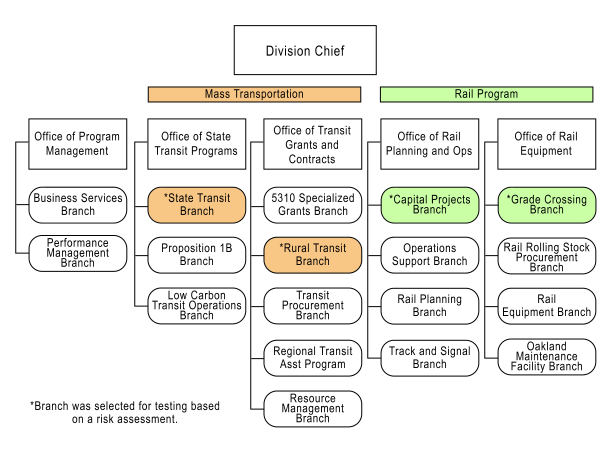
The offices are organized based on whether the branches and programs are for mass transportation or rail and by funding source (state or federal). The Office of Program Management was established in January 2018 and is responsible for administrative support and business services. The other offices are responsible for administering and managing state and federal transit and rail programs with a total of 16 branches to carry out those responsibilities. The Office of State Transit Programs administers state-funded transit programs and is assisted by district planning offices in facilitating procurement processes including requesting allocation of funds and processing and executing contracts. The Office of Transit Grants and Contracts administers Federal transit programs, the Office of Rail Equipment administers federal rail programs, and the Office of Rail Planning and Operations administers state intercity capital rail programs.
Procurement Process Evaluated
Our interviews determined the Division follows the procurement process identified in the flowchart to execute contracts and grants: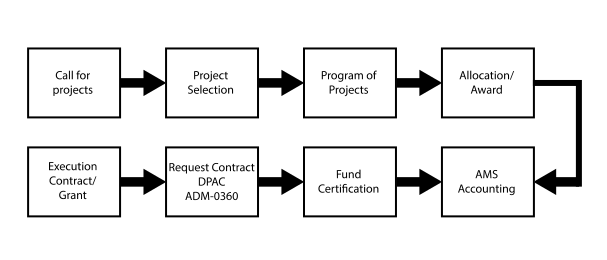
The Division executes services contracts, master agreements, program supplement agreements and interagency agreements with local, transit, and public agencies to fund their rail and transit projects. Contracts are funded by state programs and Federal Highway Administration (FHWA). Federal Transit Administration (FTA) and Federal Rail Administration (FRA) provide grants to sub-recipients to fund transit projects, vehicles, maintenance, equipment, and program costs. As the State Contracting Manual uses the term contract and agreement interchangeably, our audit report will also use these terms interchangeably.
Our audit disclosed that the Division is aware that internal control weaknesses exist and has taken steps to begin integrating the rail and mass transportation programs and address the need to centralize processes and procedures. The audit also identified the following areas where further improvements could be made, and resources better utilized:
- Contracts and grants are executed without proper delegated authority.
- Organizational structure and program administration can be improved.
- Internal control weaknesses exist over procurement practices.
- The Division administers the Grade Crossing Program without full authority.
This report is a matter for public record and will be placed on IOAI’s website, which can be viewed at <ig.dot.ca.gov>.
We requested and received a written response to our findings from the Acting Division Chief, Division of Rail and Mass Transportation. Please see Attachment 1 for their response.
The audit found that the Division of Rail and Mass Transportation (Division) staff are executing contracts and grants without proper delegation of authority. The lack of delegation of authority to execute contracts and grants can bring into question the validity of the agreements when a person without authority executes the documents. Specifically, we found the Division is executing:
- Federal grants without delegated signatory authority from the Director.
- All contracts without delegation of authority from the Division of Procurement and Contracts (DPAC) except for the intercity rail and Amtrak contracts.
- State grants for the Transit and Intercity Rail Program (TIRCP) without delegated authority.
Our interviews with Division management, Legal, and DPAC determined there is no process to monitor or ensure all delegations are appropriate, clearly stated, and current. For example, the Director’s delegation to the Deputy Director of Planning and Modal did not provide signatory authority to execute grants. In addition, the Division entered into a delegation agreement with DPAC in November 2017 for some of its rail programs, but did not request authority to execute contracts for all programs it administers. Some managers believe their authority comes from state law including Government Code Section 14031 and Streets and Highway Code Section 2500. Based on our review, we determined state law provides the Director with authority to execute contracts but not the Division. The SCM, Volume 1, Section 2.06, Authority to Sign a Contract, requires that contracts must be signed by a person with statutory authority or duly authorized in writing. Section 2.15, Elements of a Valid Contract, requires a valid signature by each party authorized to bind that party.
The Division staff believe TIRCP to be a grant program and not subject to DPAC delegation. We determined the TIRCP is a state-funded program delegated by California State Transportation Agency (CalSTA) and administered by the Division. The SCM cautions agencies not to misclassify state-funds as grants. According to Volume 1, Section 4.06, Certain State and Federally Funded Grants Exempt from Approval by Department of General Service (DGS) performance under a grant must not be controlled by the State. The grant must fund the grantee’s program and not the State’s program. The Division established the Office of Program Management in January 2018 to ensure contracts and grants are executed in compliance with federal and state laws and DPAC policies and requirements. The office is aware of the delegation issue but will need the assistance of DPAC and Legal to develop the appropriate solution.
RECOMMENDATION
We recommend the Division:
- Work with Caltrans Legal to establish the Division’s source of authority to execute federal and state contracts and grant agreements for all programs administered.
- Work with the Director’s Office to update the delegation memo to include appropriate signatory authority.
- Work with DPAC to obtain required delegation agreements.
- Establish processes and procedures for maintaining delegated authority and delegation agreements.
DIVISION OF RAIL AND MASS TRANSPORTATION'S RESPONSE
The Division of Rail and Mass Transportation concurred with the finding and recommendations and will take steps necessary to address them. Please see Attachment for details of the response and action plan.
Findings and Recommendations 2 - Organizational Structure and Program Administration Can Be Improved
The Division of Rail and the Division of Mass Transportation organizationally merged into one division in July 1, 2014, however the business functions have not been integrated, and the rail and transit programs continue to function independently. Since the merger, there has been high turnover of key management and staff. A Division Chief was not appointed until January 2018, and there are vacant Chief positions in three of the five Offices. Branch managers are acting as Office Chiefs on a rotational basis in addition to fulfilling their own responsibilities, and the majority of key staff interviewed have tenure of less than one year. The Division contracted with a consultant in 2015 to assist with integrating the two divisions; however, with high turnover of key management, efforts were put on hold until January 2018.
The absence of key management and lack of integrated business processes has affected the Division’s ability to effectively administer and manage state and federal transit and rail programs. Its decentralized processes and procedures and uneven distribution of workload has further impacted its ability to meet its goals of providing excellent stewardship of public transportation funds and excellent service to its customers and partners.
Government Code Section 13403 (a) states in part, “Internal accounting and administrative controls, if maintained and reinforced through effective monitoring systems and processes, are the methods through which reasonable assurances can be given that measures adopted by state agency heads to safeguard assets, check the accuracy and reliability of accounting data, promote operational efficiency, and encourage adherence to prescribed managerial policies are being followed.”
Decentralized Processes and Procedures
The Division has decentralized processes and procedures for administering and managing programs, monitoring and tracking contracts and program funding, and resource management. Specifically, we found:
- The Division’s current organizational structure is not set up to manage total project costs, rather branches manage contracts for each rail and transit funding component of the projects.According to management, there is an informal process for establishing a project lead; however, it is not always followed due to lack of communication. The lack of project coordination with no centralized contract management system makes it difficult to administer and manage contracts.
- Three branches are responsible for administering and managing state-funded transit and rail programs that fund local and transit agency projects. Each of these programs are subject to the same procurement requirements, however, we determined the branches use different procurement processes and procedures for managing the programs. For example, the Grade Crossing Program executes services agreements, the State Transit Program executes master agreements and program supplements, and the Capital Projects Rail Program executes modified services contracts.In addition, multiple branches administer different funding components of the project and the local and transit agencies are required to submit multiple allocation requests. The Division of Local Assistance (DLA) also requires local agencies to submit allocation requests for the same project. This redundancy causes work load challenges for local and transit agencies.
- The Division does not have a centralized system for tracking, monitoring and managing contracts and funding for programs administered.During interviews, we found that key management staff were not aware of the programs administered by the Division and the amount of funding for each program. Contract managers create their own Excel spreadsheets or rely on reports from Caltrans financial accounting system, and this information is not maintained in a centralized tracking system. Without a centralized system, the Division will not be able to effectively manages it contracts and grants.
Recently, the Office of Program Management began developing a process for monitoring and tracking funding. However, we did not review this process because it was not completed prior to the end of our fieldwork.
Not only are processes and procedures decentralized within the Division, DLA also works with local agencies and is subject to the same state and federal requirements. To the extent that procurement processes for these programs are similar, DLA and the Division should work together to identify duplicative requirements and streamline processes. For example, the Division and DLA both execute separate master agreements with local agencies having similar requirements for state and federal funded projects. The Divisions should consider whether these functions could be consolidated in DLA and provide efficiencies for Caltrans and local agencies.
Uneven Distribution of Workload
We evaluated the workload of selected branches by comparing the number of grants and contracts executed by the number of staff and found it does not appear to be evenly distributed. Although there may be different requirements, the procurement processes are basically the same for all branches.
| Branch Offices | Est. Contracts/Grants Executed Annually | No. of Staff | Average Executed |
|---|---|---|---|
| Capital Projects Branch | 16 | 4 | 4 |
| State Transit Branch | 33 | 5 | 7 |
| Grade Crossing Branch | 50 | 2* | 25 |
| Rural Transit Branch | 90-100 | 5 | 20 |
*The number of current staff in Grade Crossing Branch is 2, however the branch has 4 positions.
As shown in the chart above, the Grade Crossing Branch has the highest number with an average of approximately 25 contracts per staff and Rural Transit Branch averaging approximately 20 per staff. Staff in the other two branches average approximately six contracts annually. When workload is not evenly distributed, it can result in delays, low employee morale, and backlog of workload.
RECOMMENDATION
We recommend the Division to:
- Continue integration efforts to manage projects by local and transit agency rather than manage each funding component of the project.
- Combine processes and procedures for programs with similar requirements and consider consolidating requirements with DLA to leverage similar processes, such as using master agreements and program supplements for the same local, transit, and public agency projects.
- Assess the feasibility for a centralized contract management system for the Division.
- Evaluate resources for properly distributing the workload.
DIVISION OF RAIL AND MASS TRANSPORTATION’S RESPONSE
The Division of Rail and Mass Transportation concurred with the finding and recommendations and will take steps necessary to address them. Please see Attachment for details of the response and action plan.
We evaluated internal controls over procurement practices based on interviews, review of documentation, and testing of 42 contracts and grant files from four branches and found the following weaknesses:
- The Division did not have policies and procedures.
- Unclear roles and responsibilities for administering delegated programs.
- Caltrans procurement policies are not followed.
- Processes are deficient or do not exist.
- Inadequate separation of duties.
The State Administrative Manual (SAM) Section 20060 defines internal control as a process effected by an entity’s oversight body, management, and other personnel that provides reasonable assurance that the objectives of an entity will be achieved. It requires all levels of management to establish and maintain a system of internal control and effective and objective ongoing monitoring of the internal controls. In addition, it states that instances where policy and procedural or operational manuals are not currently maintained, or lines of organizational authority and responsibilities are not clearly indicated or are nonexistent, are symptoms of control deficiencies. This section urges management to identify and make necessary corrections when warned of these symptoms.
The Division Did Not Have Policies and Procedures
The Division has not established policies and uniform procedures to communicate and implement state and federal requirements with exception of the Office of Transit Grants and Contract through the FTA State Management Plan. The Division uses program guidelines from various stakeholders such as CalSTA, California Transportation Commission (Commission), and California Public Utilities Commission as operating procedures and for communicating program requirements. However, these program guidelines are general, and the Division has not developed policies and procedures to implement the guidelines. Branches we evaluated have created internal written desk procedures for most of the programs administered, however they are not sufficient to serve as policy, guidelines, and procedures for meeting state and federal requirements.
We found that without specific policies and procedures, local and transit agencies are getting conflicting guidance on procurement processes and requirements. The Division would benefit from establishing a division-wide manual because it would provide a clear communication and guidance tool for stakeholders and employees.
The Division is responsible for ensuring the consistent application of standards, policies, and state and federal laws and regulations as part of its delegated authority to administer and oversee rail and mass transportation programs. Policies and procedures are necessary to ensure accountability, consistency, and compliance, and they should communicate:
- The Division’s authority over the programs it administers.
- Roles and responsibilities for all stakeholders.
- Requirements for implementing and administering the programs.
- Consistent standard operating processes and practices.
- Compliance and enforcement of requirements.
Unclear Roles and Responsibilities for Administering Delegated Programs
The Division was delegated responsibility for administering various programs, including TIRCP, Rail Capital Projects, and State Transit Programs, however the roles and responsibilities are unclear. If roles and responsibilities are not clearly defined, this can create confusion among Division staff and local agencies. Specifically, we found:
- Transit and Intercity Rail Capital Program - CalSTA delegated responsibility for administering the Transit and Intercity Rail Capital Program to Caltrans on August 17, 2015.Although the delegation of responsibility in the memorandum states that Caltrans will be responsible for administering this program, however the delegation is not clear on Caltrans’ roles and responsibilities.In addition, the TIRCP guidelines issued by CalSTA do not clearly distinguish Caltrans roles and responsibilities.For example, the guidelines task CalSTA and Caltrans with requesting additional documentation to support applications, determining whether to recommend projects to the Commission for action, and preparing appropriate agreements with the agencies, but it is unclear who performs the procedures.A formal delegation should include the scope and limits of authority and clearly define the roles and responsibilities to ensure efficient administration, compliance with requirements, and to prevent confusion to those tasked with administering the Program as well as other stakeholders.
- Rail Capital Projects – This program does not have processes or procedures for nominating projects and preparing the program of projects for Commission approval. Various Commission program guidelines state Caltrans’ involvement in developing the State Transportation Improvement Plan and Intercity Rail Improvement (IRI) plan, however it is unclear who in Caltrans develops the list. The Division believes they work within the guidelines; however, there are no policies stating Caltrans roles and responsibilities.
- State Transit Programs - Roles and responsibilities between the State Transit Branch and the district planning offices are not clear for assisting local agencies with state-funded transit programs.According to the Branch Manager, the Division entered into district agreements to outline the roles and responsibilities, however the agreements could not be provided. The branch’s desk manual states that both the branch and districts assist local agencies with requests for allocations and execution of contracts. The Division provides districts with resources to perform these functions; however, testing of contract files found that branch staff do the work.
Formal delegations of authority should include the scope and limits of authority and clearly define roles and responsibilities to ensure effective program administration and compliance with requirements.
Caltrans Procurement Policies are Not Followed
We tested adherence to Caltrans procurement policies and found the Division does not adhere to the following requirements:
- Ethics Orientation Training – We evaluated a division-wide mandatory training schedule provided by the Office of Program Management and found that the Division is not in compliance with Caltrans’ ethics training policy.We found that eight managers and 13 contract managers involved in the contracting process had not taken ethics training.
- Caltrans’ Deputy Directive, DD-114-R1, Buyer Responsibilities, requires that any employee involved in the purchasing process take mandatory biennial ethics training.Conflict of Interest – Managers and staff in three of four selected branches had not signed the required Conflict of Interest form (ADM-3043).Caltrans’ Deputy Directive, DD-009-R5, Incompatible Activities and Conflict of Interest, requires staff involved in preparing and approving procurement documents, approving payment, etc. are required to sign the conflict of interest form.
Managers and staff were not aware of the policy requiring employees involved in the procurement process to take mandatory biennial ethics training and maintain sign the conflict of interest form. By not complying with the requirements, staff may not be held accountable for unethical behavior or incompatible activities.
Processes Are Deficient or Do Not Exist
Our testing of 42 contracts and grants from four selected branches found the following deficiencies:
- Contracts are not always complete, accurate or timely:
- Five out of nine state transit master agreements did not contain required DGS provisions, including Statements of Compliance, Drug-Free Workplace, Recycled Content; and four didn’t include Air/Water Pollution Certification or Prompt Payment.
- Grade Crossing safety contracts included effective dates up to one year prior to the date of execution, and two state intercity rail contracts had effective dates of two years prior to execution.
- Nine out of 11 state transit program supplement agreements lapsed prior to renewal or amendment.
- All master agreements for TIRCP projects did not include an execution date.Without this information, there is no way to determine when and how long these agreements are effective.
- Certification of funding was not done prior to execution for 21 of 42 contracts. In addition, we found certification of funds forms were signed by three unauthorized employees.
- Project coding information for 11 projects was not correctly input in the Caltrans financial accounting system.
- Three branches did not have processes for ensuring allocation requests are complete, accurate, and submitted timely.
- Contract files did not contain proper documents including contract manager training certifications, programming documents, allocation requests, environmental, and right of way certifications.
These internal control weaknesses were caused by a lack of policies and procedures, staff’s lack of knowledge of procurement requirements, and oversight of the procurement process. Staff that lack necessary knowledge, expertise, and training can affect the Division’s ability to meet its goals and objectives and can lead to delays, process deficiencies, and errors. The SCM Volume 2, Section 11.1.2, states that a contract administrator must have sufficient knowledge of contracting principles as it relates to their responsibilities in administering the contract.
Inadequate Separation of Duties
Our audit found that the current responsibilities for resource management is decentralized and has created inadequate separation of duties within the Division. The four offices reviewed were performing both procurement functions as well as resource management functions. We reviewed the duty statements of contract and branch managers and found that neither have responsibilities for resource management. Based on the delegation memo from the Division Chief, we found the responsibilities for resource management belongs within the Office of Program Management. Resource management processes include: preparing the programming document for Commission approval, coding project information in Caltrans financial accounting system, certifying availability of funds, and creating a contract in the financial accounting system.
The Office of Program Management has oversight responsibilities to ensure compliance with these requirements. The office began implementing processes and reviewing contracts and grants for some branches to ensure compliance, however these and other resource management processes were being implemented during our audit.
RECOMMENDATION
We recommend the Division:
- Develop a single source policy and procedures manual to include uniform processes and procedures to ensure compliance with state and federal requirements.
- Establish clear roles and responsibilities by:
- Meeting with CalSTA to define and clarify the scope and limits of authority of the formal delegations for TIRCP and Rail Capital Projects.
- Establishing agreements with district planning offices for assisting local agencies with state-funded transit programs.
- Ensure staff adhere to the requirements of mandatory training and the conflict of interest policy.
- Establish oversight and monitoring processes and procedures to ensure contracts and grants are complete, accurate, and timely; and, procurement requirements are followed.
- Transfer resource management functions to the Office of Program Management to ensure adequate separation of duties over procurement functions.
DIVISION OF RAIL AND MASS TRANSPORTATION’S RESPONSE
The Division of Rail and Mass Transportation concurred with the finding and recommendations and will take steps necessary to address them. Please see Attachment for details of the response and action plan.
DLA transferred authority over the federal Grade Crossing Program 130, along with 1.5 positions, to the Division of Rail in 2002, however program responsibilities were never fully transferred. According to DLA’s memorandum to the Division dated January 14, 2002, the obligation authority would remain with DLA until federal fiscal year 2002/03; DLA would continue to assist with the program until processes were established; and, local agency invoices would continue to be processed through Local Program Accounting until new arrangements could be made with Division of Accounting. However, we found that the terms outlined in the memorandum were not fulfilled. Specifically, we found the Division has not:
- Obtained obligation authority.
- Obtained program budget authority.
- Developed processes and procedures for monitoring timely use of funds, processing invoices, and reviewing environmental requirements.
RECOMMENDATION
We recommend the Division work with DLA to determine whether to complete the transfer of the Grade Crossing Safety Program 130, including budget authority and all program responsibilities, or transfer the program back to DLA.
DIVISION OF RAIL AND MASS TRANSPORTATION’S RESPONSE
The Division of Rail and Mass Transportation concurred with the finding and recommendations and will take steps necessary to address them. Please see Attachment for details of the response and action plan.